
Venice: Museum Elopement, City Elopement and Nature Elopement
February 23, 2026

Venice: Museum Elopement, City Elopement and Nature Elopement
Which form of intimacy suits you?
An elopement has long been more than a secret wedding for two. It is a conscious decision to reduce, to focus on the essentials — and for a backdrop that supports your story instead of superimposing it.
But even within an elopement, there are different approaches: a classic nature elopement, an urban city elopement or a museum elopement.
Especially in a city like Venice, which itself looks like an open museum, these categories are blurred. And yet they differ significantly in atmosphere, light, planning and effect.
This article compares three equivalent concepts based on specific criteria: atmosphere, lighting conditions, planning effort and photographic options.
Museum Elopement — When culture becomes a resonance space
While couples all over the world choose between beach paradises in the Caribbean, mountain peaks in the Dolomites or fog-shrouded highlands in Scotland, there is a third option that is often overlooked: cultural spaces. A Museum-Elopement It is not a trend, but an attitude.
Instead of the force of nature or urban dynamism, you opt for curated spaces, for architecture with history, for an environment that already has meaning. Works of art, sculptures, historic rooms or modern exhibition spaces do not become decoration, but the silent context of your ceremony.
The atmosphere is concentrated, almost contemplative.
Acoustics are attenuated.
Light is soft, often controlled.
A museum elopement feels structured, calm, consciously composed. It is particularly suitable for couples who appreciate art, design and cultural depth and see their wedding as an overall aesthetic concept.
In planning terms, this means: Approvals, time arrangements with institutions, clear processes. But it is precisely this structure that creates a special exclusivity.

City Elopement — Urban energy with intimacy
A city elopement uses the city's architecture as a stage. Squares, bridges, facades and water areas become natural settings for your ceremony.
In a city like Venice, this creates a particular tension: between world-famous scenery and intimate moments at dawn or in quiet side streets. The urban environment remains alive — but it becomes part of your story.
Atmospherically, a city elopement is more dynamic than a museum elopement.
The light is more changeable.
Noise is part of it.
It's less controlled but often cinematic. Ideal for couples who love movement, contrast, and urban aesthetics.

Nature Elopement — Elements as Silent Witnesses
The classic elopement is often associated with nature: cliffs, forests, mountains, vast landscapes.
Here, wind, light and weather take over the staging. The atmosphere is open, organic and more immediate than in a museum or in the city. Natural elopements are emotionally intense — but also unpredictable.
In terms of planning, this means: weather windows, flexibility, alternatives.
Photographic: Golden hour, dramatic sky, soft movements of substances in the wind.
It is the most original form of elopement — reduced to two people and the landscape.

Elopement in Venice — When city, art and culture merge
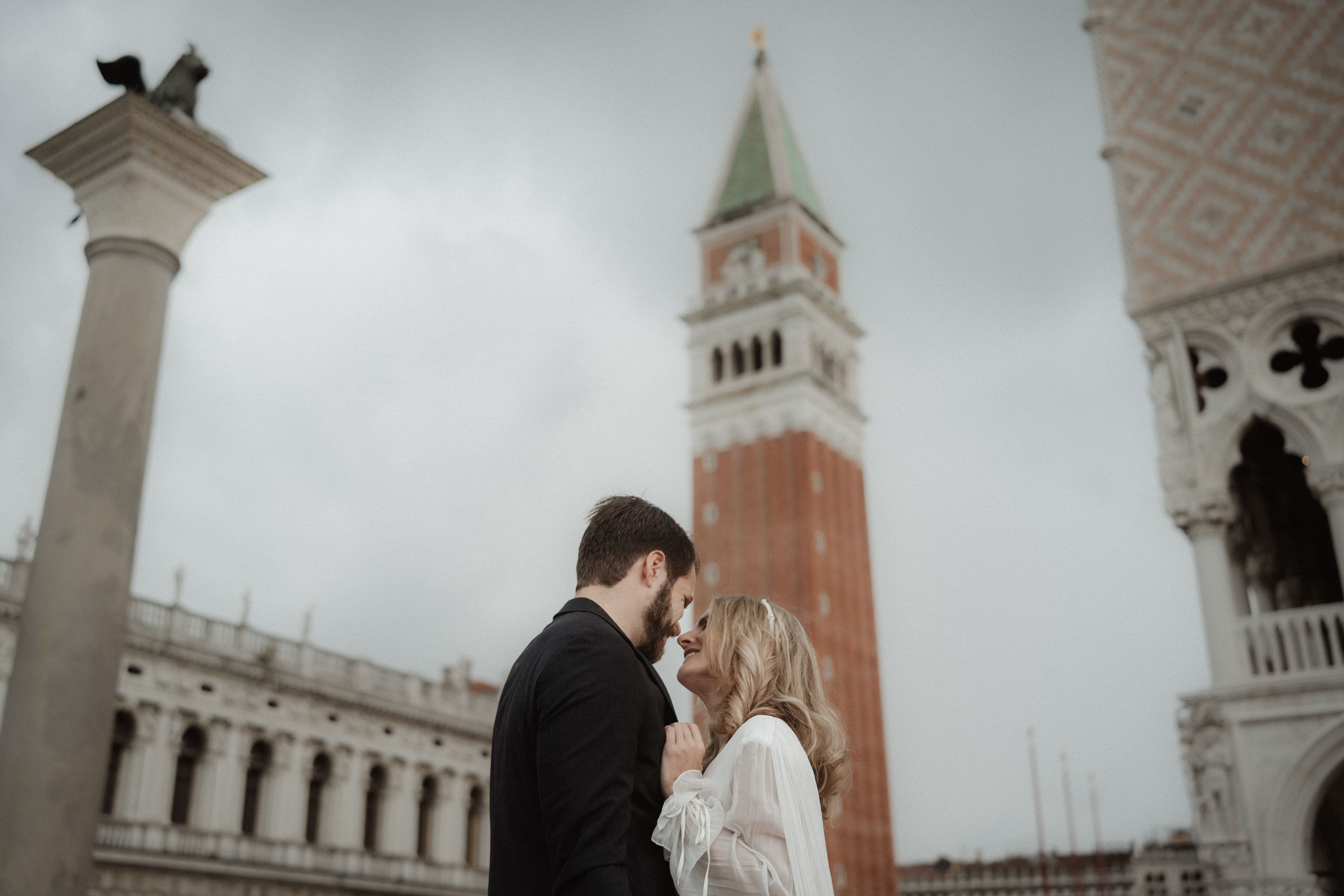
Venice is not a place that can be clearly assigned to a category. The city is not just a museum, nor a pure city location or a classic natural backdrop. It is everything at the same time. An urban network of water, history, architecture and art — like a open open-air museum. Anyone who opts for an elopement in Venice is not choosing a single backdrop, but an atmosphere in which city, culture and aesthetics are inextricably linked.
Between palaces, canals and quiet courtyards, an intimacy is created that seems surprisingly calm — even in a world-famous metropolis. Venice carries history in every surface: in weathered facades, in light reflections on the water, in arches and staircases that have been walked on for centuries. This visual density makes the city a stage that doesn't have to be staged. It is already curated.

Venice as an open museum
In Venice, interior and exterior spaces merge in a special way. Architecture becomes a gallery, spaces become exhibition spaces, bridges become frameworks for encounters. Art and everyday life coexist here, without disruption. That is exactly what makes the city so special for an elopement.
Saying yes in Venice doesn't feel like an event, it feels like a moment. The city doesn't look decorated, but grown. It gives you a cultural context without imposing yourself. Your story becomes part of a larger whole — quiet but powerful.
For couples who appreciate art and architecture, a visual language is created here that has depth. Light falls softly between buildings, is reflected in the water and shapes faces in a natural way. Instead of spectacular force of nature or urban volume, a concentrated, almost cinematic atmosphere is created.
Atmosphere instead of category
While many destinations clearly follow one direction — mountain, beach or metropolis — Venice eludes this division. The city offers urban structure, cultural substance and landscape at the same time. The water creates space, slows down movements and dampens noises. Even central locations look surprisingly intimate early in the morning or late in the evening.
This complexity makes Venice ideal for couples who are not looking for a classic backdrop, but an atmosphere. A place that doesn't feel like a photo location, but like a living space with a story.
Planning in a city with history
An elopement in Venice requires sensitivity and experience. The city is unique — and that is exactly why there are special rules. Time windows must be chosen consciously, permits may be necessary, and logistics work differently than on the mainland. Transports run over water, routes are winding, and every decision influences the process more than in an ordinary city.
That is precisely why a precise planning decisively. Not to create control, but to make lightness possible. Anyone who knows the processes knows when the city becomes quiet, where light falls best and how to create intimacy even in familiar environments.
Who is an elopement in Venice ideal for?
For couples who see their wedding not as an isolated event but as a cultural moment. For people who appreciate art, architecture and history — without sacrificing urbanity.
For anyone who doesn't want to choose between city, museum or nature, but is looking for everything in one.
Venice is not a backdrop.
Venice is context.
A city that keeps what stays.
Planning and expertise: From permits to exclusive access
Each type of location entails different planning requirements. Museums require approval processes four to nine months in advance and coordination with curators. City Elopements need flexible time slots to avoid crowds. Nature locations depend on the weather and often require additional logistical planning for access and infrastructure.
Time frame and lead time: Museum vs. City vs. Nature
Museum elopements need the longest lead time. For exclusive access, you can count on four to nine monthsbecause permits must be coordinated with museum staff. Above all, city locations need perfect timing and less bureaucracy. Three to six months are usually enough for photographer permits and registry office coordination. Nature locations depend on the weather, so plan flexible alternative dates one.
Guest experience and intimacy: What ten people feel like depending on the setting
Ten guests in a museum create a concentrated, almost contemplative atmosphere. Surrounded by art or architectural history, the result is a calm, focused atmosphere in which every word is given weight. Subdued acoustics and clearly defined spaces reinforce the feeling of presence — the ceremony almost looks like a deliberately set moment outside everyday life.
In an urban setting, the same number of guests becomes part of a lively environment. Architecture frames the moment, while urban life continues quietly in the background. Noise, changes of light and movement create dynamic energy. In nature, on the other hand, a small group is more freely distributed in space. Wide landscapes allow for retreat, conversations away from the main group and a more intimate, organic dynamic. Here, it is not architecture but a sense of space that defines the ceremony.

Dress code and practical details: fabrics, shoes and color palettes depending on the location
The choice of location not only influences the atmosphere, but also style and materials. Textured, high-quality fabrics such as silk, satin or heavy crepes look particularly elegant in museum rooms. Clear lines and restrained color palettes harmonize with curated interiors and controlled lighting. Smooth floors allow longer hauls and finer shoe models.
In urban environments, more robust materials and textured fabrics are often more practical. Mikado or firmer fabrics keep their shape when there is wind or movement, and sturdier heels make walking on pavement or uneven surfaces easier. In nature, on the other hand, fabrics may be more flowing — chiffon, organza or softly falling silhouettes react sensitively to wind and light. In terms of color, natural nuances are particularly harmonious, while stronger tones can be staged more strongly in urban settings.
Photography in detail: lighting, backdrops and special technical features

Museum lighting: Working without flash — atmosphere instead of overexposure
Museums offer a special but sophisticated photographic environment. For conservation reasons, flashes are not allowed in most houses to protect works of art. At the same time, museum spaces are often deliberately kept darker in order to protect sensitive exhibits from too much light. For photographers, this means working with existing light, high sensitivity to lighting and a deep understanding of the effect of space.
The existing light is usually soft and diffuse, comes through tall windows or skylights and is supplemented by restrained exhibition lighting. This does not create hard shadows, but soft transitions and a calm, almost picturesque lighting atmosphere. The darker environment creates depth and concentration — faces are modeled, textures emerge subtly, and the image effect acquires a silent intensity.
The greatest feature of a museum building therefore lies not in technical perfection, but in the atmosphere. Photographs are taken with light that is already there — not with additional presentation. This reduced approach creates intimate, timeless images with cultural depth. At the same time, it requires experience: longer exposure times, smooth movements and precise planning are decisive for authentically capturing the atmosphere of the room.
City photography: contrasts, movement and architectural lines
Urban elopements depend on architectural dramaturgy. Façades, arches, stairs, squares or bridges act as natural picture frames and give photographs graphic clarity. At the same time, contrasting lighting situations often arise: deep shadows between buildings, bright reflections on stone or glass, changing lighting conditions over the course of the day.
These contrasts can be used specifically for cinematic imagery. Movement in the background, urban noises or flowing lines reinforce the dynamics of the recordings. The technical challenge lies in dealing with a strong game of light and dark — but this is exactly what often results in particularly expressive images. Anyone who takes pictures early in the morning or at off-peak times also gains peace and an almost intimate city backdrop.
Natural light: Space, golden hour and weather as a design element
In Natur-Elopements, light becomes the central actor. Golden Hour in particular — the warm evening light falling in from the side — creates a soft, almost floating atmosphere. Backlight shots in which the sun is behind the couple create glowing contours and an emotional image effect.
In contrast to museums or cities, the light here is not controllable — and that is precisely where its appeal lies. Clouds, fog or wind become design elements. Every weather situation tells a different visual story. Nature elopements therefore require flexibility and good timing, but in return offer an authenticity that can hardly be staged. The relaxed structure of an elopement makes it possible to react to changes in light and consciously capture the best moments.
For this post, I'm using the images from Karo Meng, a photographer who specializes in elopements and intimate weddings has. Her work is characterized by a subtle, atmospheric visual language that focuses on proximity and authenticity. Instead of staged perfection, she captures real movements, looks and nuances — with a sense for light, architecture and the quiet moments of a day. Especially during an elopement in Venice, where city, history and emotion flow together, she succeeds in making the connection between couple and place visible. Her pictures don't tell a show, but a story — calm, aesthetic and full of emotion.


